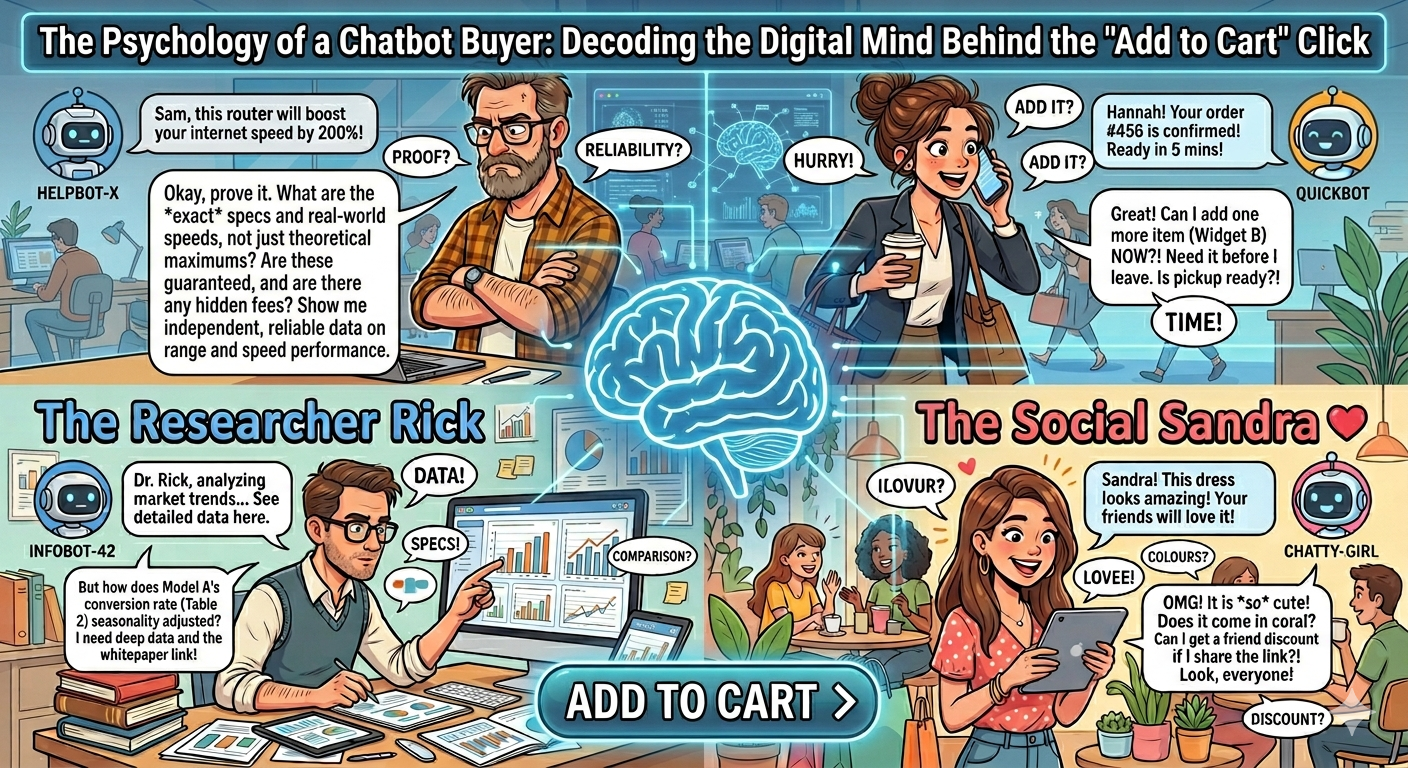
The Psychology of a Chatbot Buyer: Decoding the Digital Mind Behind the "Add to Cart" Click
Ever wondered what goes through someone's mind when they're chatting with a bot about buying software? Spoiler alert: It's not as robotic as you think.
In 2026, with 68% of customers having used a chatbot for customer service and 47% open to buying products through chatbots, understanding the psychology behind these digital conversations isn't just nice-to-have — it's essential. Let's dive into the minds of your chatbot buyers and discover how to turn casual browsers into committed buyers.
Meet Your Chatbot Buyers: The Four Archetypes
Not all buyers are created equal. When it comes to chatbot interactions, you'll typically encounter four distinct psychological profiles:
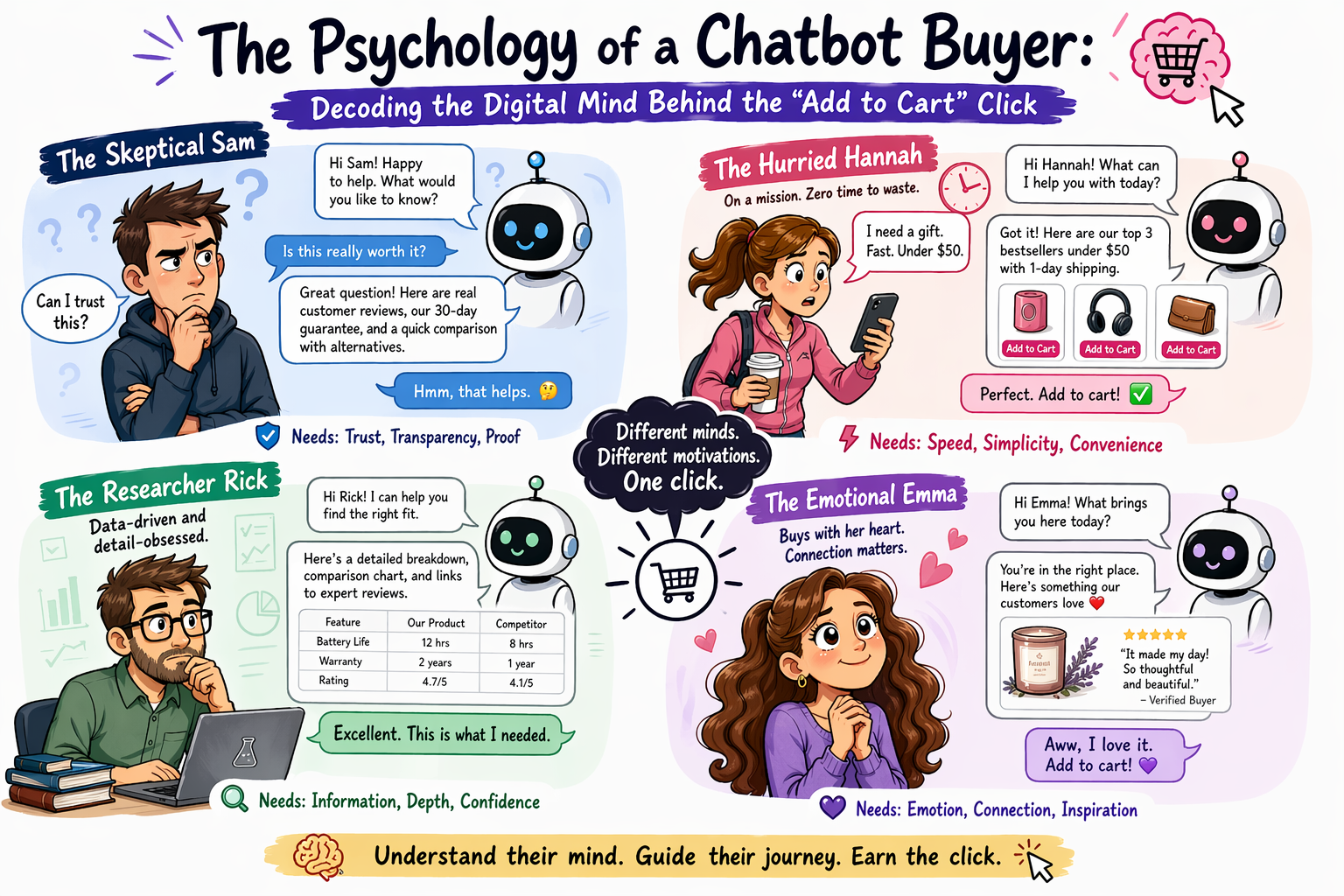
1. The Decisive Dani (12% of buyers)
"Just give me the price and the ROI calculator."
These buyers know what they want. They're command-oriented, time-poor, and hate fluff. Research shows that responsiveness is one of the three key drivers of chatbot preference in B2B contexts.
- Psychological trigger: Speed and efficiency
- Red flag: Long qualification processes
- Green light: Direct answers, pricing transparency, instant demo booking
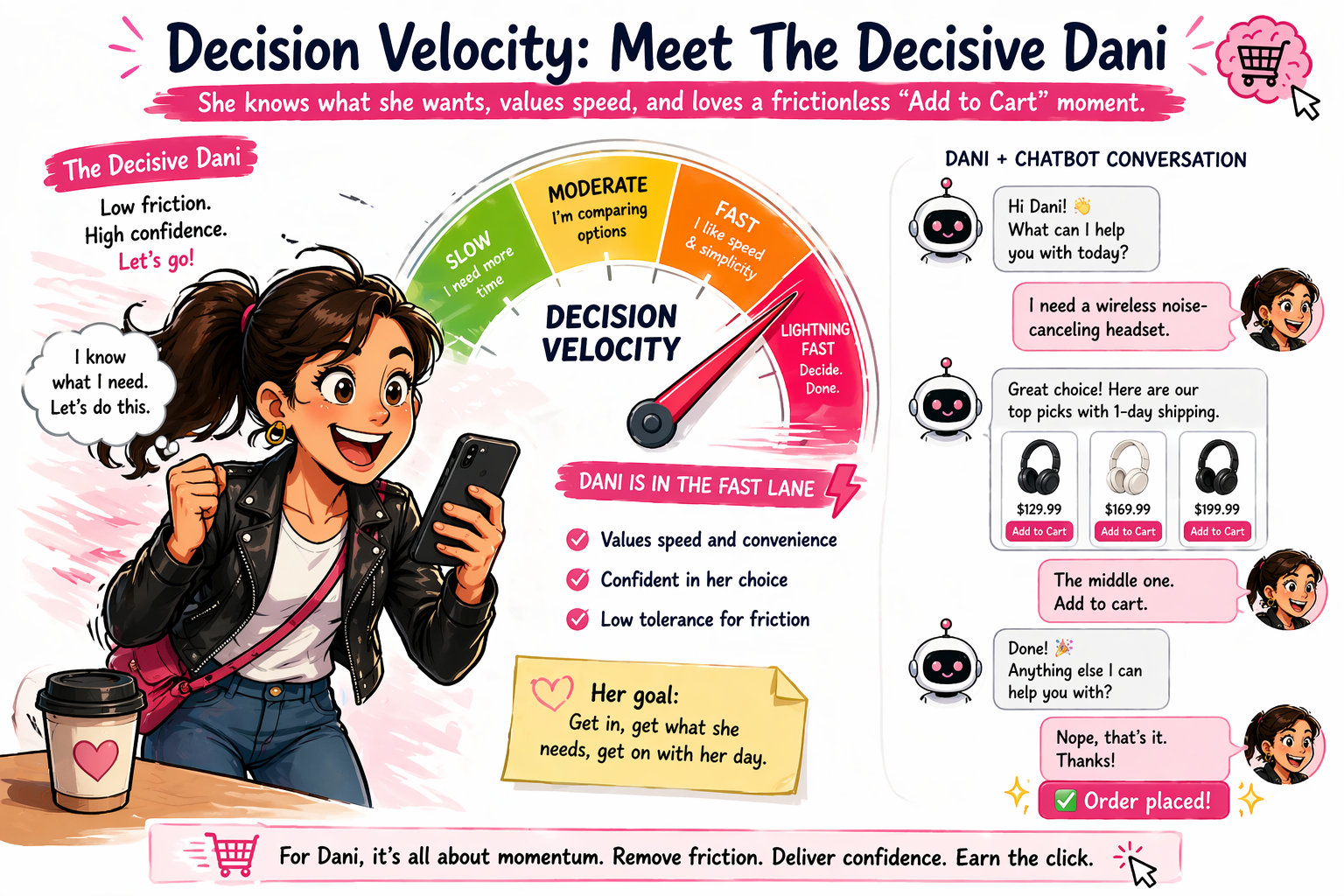
2. The Skeptical Steve (34% of buyers)
"How do I know this isn't just another overpromising SaaS tool?"
Here's the kicker: B2B buyers trust peer recommendations nearly twice as much as AI chatbots. Steve knows this. He's been burned before, and he's not about to let a chatbot convince him otherwise.
- Psychological trigger: Social proof and security
- Red flag: Overly enthusiastic bot responses
- Green light: Case studies, security badges, third-party integrations, transparent limitations
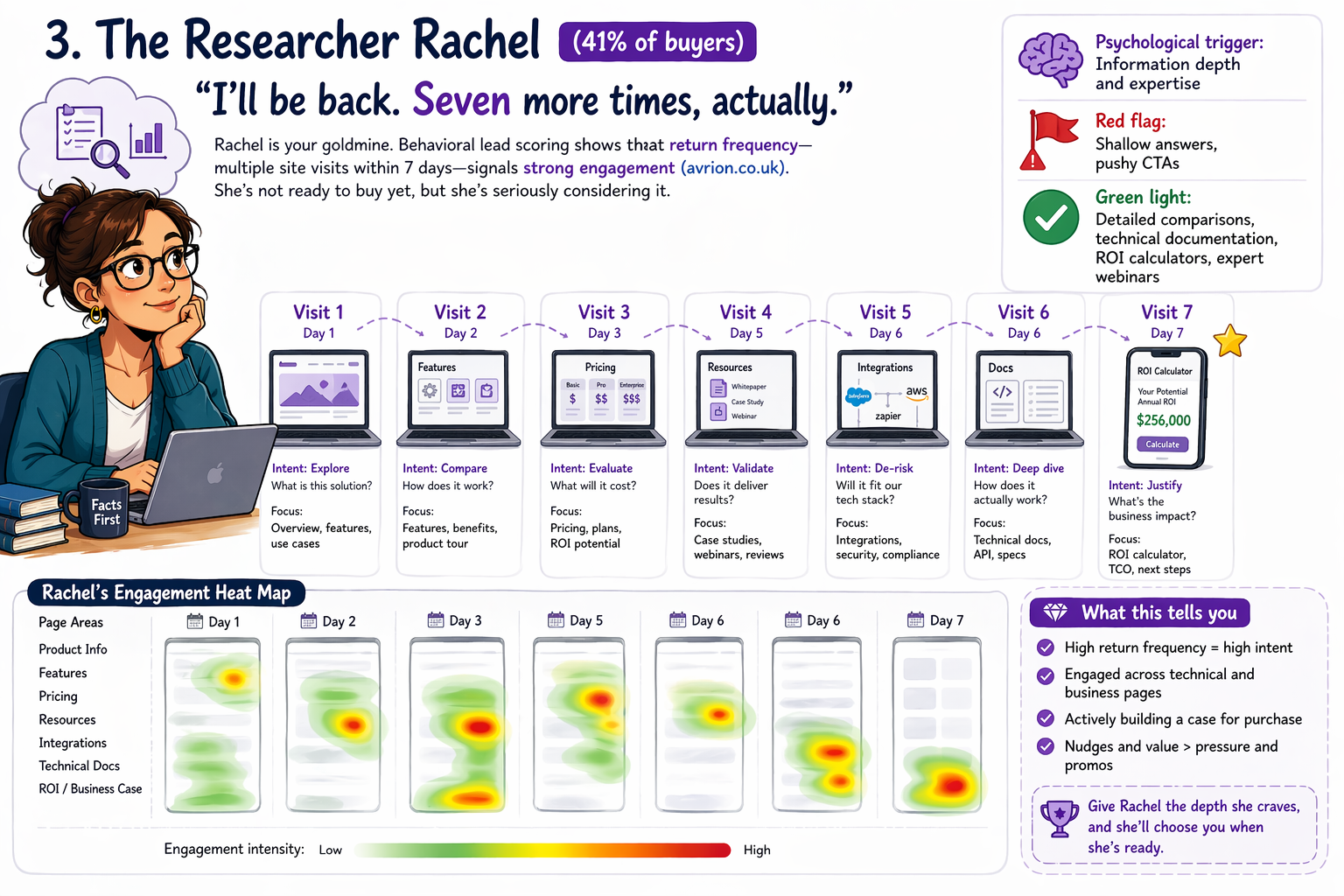
3. The Researcher Rachel (41% of buyers)
"I'll be back. Seven more times, actually."
Rachel is your goldmine. Behavioral lead scoring shows that return frequency — multiple site visits within 7 days — signals strong engagement. She's not ready to buy yet, but she's seriously considering it.
- Psychological trigger: Information depth and expertise
- Red flag: Shallow answers, pushy CTAs
- Green light: Detailed comparisons, technical documentation, ROI calculators, expert webinars
4. The Relational Ryan (13% of buyers)
"Can I talk to someone who actually understands my business?"
Ryan craves human connection, even in a digital world. While chatbots can boost website conversions by up to 35%, Ryan needs to know there's a human backup plan.
- Psychological trigger: Personalization and empathy
- Red flag: Obvious script loops, no human handoff
- Green light: Context-aware conversations, seamless escalation, personalized recommendations
The Digital Breadcrumb Trail: Reading Navigation Patterns
Your chatbot buyer leaves clues everywhere. The trick is knowing what to look for.
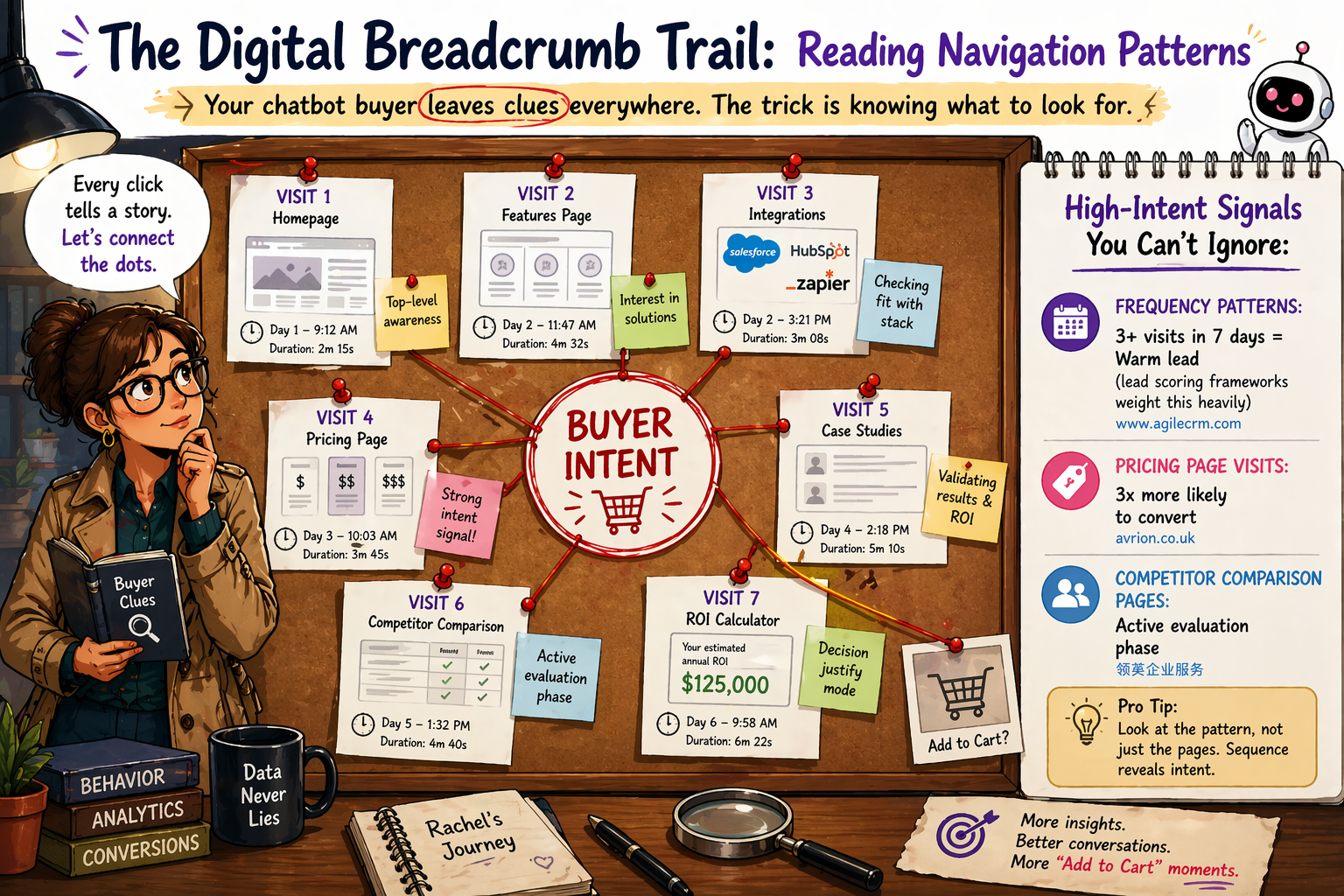
High-Intent Signals You Can't Ignore
Frequency Patterns:
- 3+ visits in 7 days = Warm lead (lead scoring frameworks weight this heavily)
- Pricing page visits = 3x more likely to convert
- Competitor comparison pages = Active evaluation phase
Time-on-Page Secrets:
- Spending 5+ minutes on integration docs? Technical evaluator.
- Bouncing from pricing in under 30 seconds? Price-sensitive or wrong fit.
- Returning to the same feature page? That's their must-have.
The Magic Number:
Companies employing behavioral lead scoring see up to 70% increase in lead generation ROI. Are you tracking this?
The Trust-Building Timeline
Here's what the research says about building trust through chatbots:
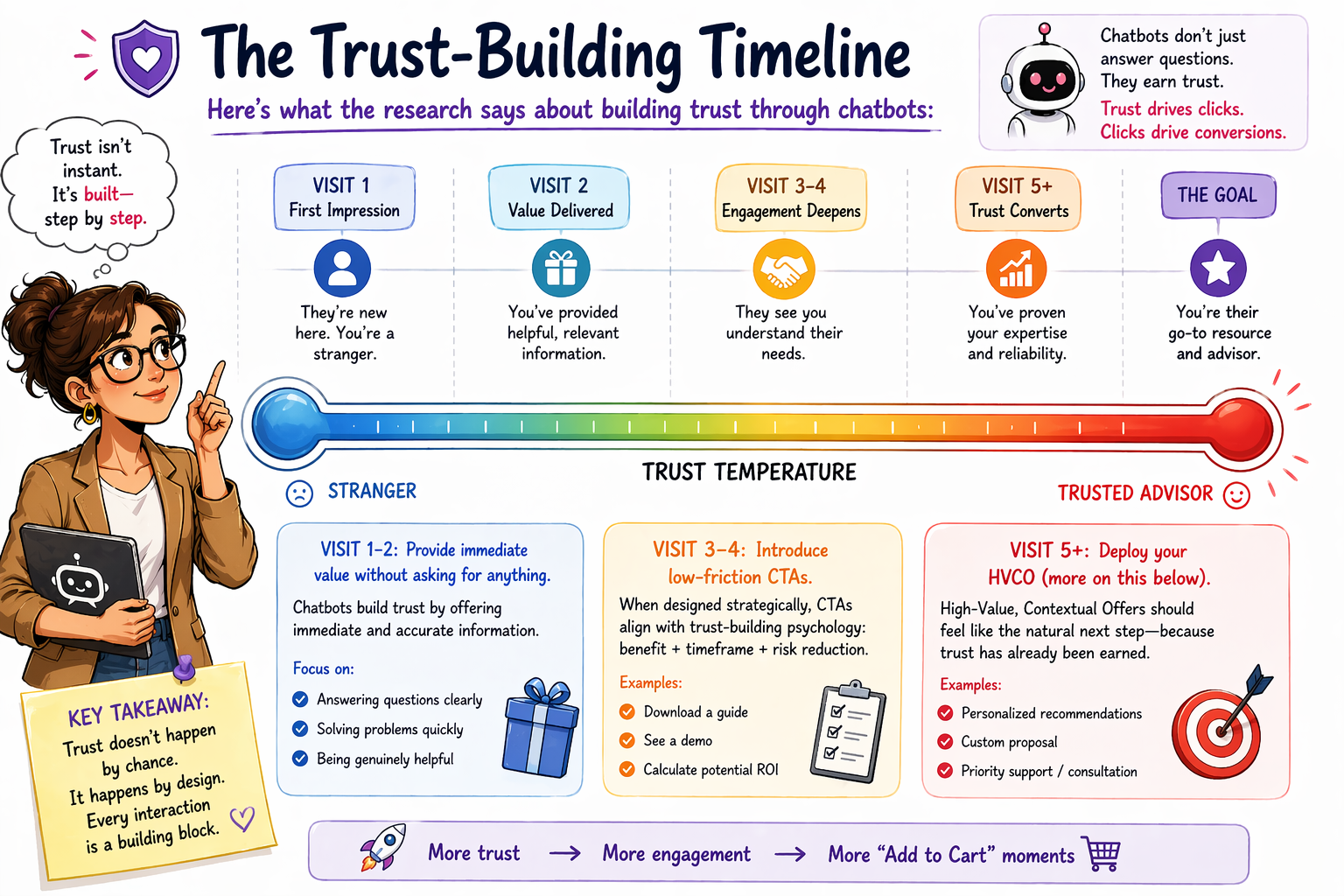
- Visit 1–2: Provide immediate value without asking for anything. Chatbots build trust by offering immediate and accurate information.
- Visit 3–4: Introduce low-friction CTAs. When designed strategically, CTAs align with trust-building psychology: benefit + timeframe + risk reduction.
- Visit 5+: Deploy your HVCO (more on this below).
HVCO: Your Secret Weapon for Lead Capture
High-Value Content Offers (HVCOs) aren't just ebooks and whitepapers. In fact, white papers now rank last for B2B buyer trust. So what works?
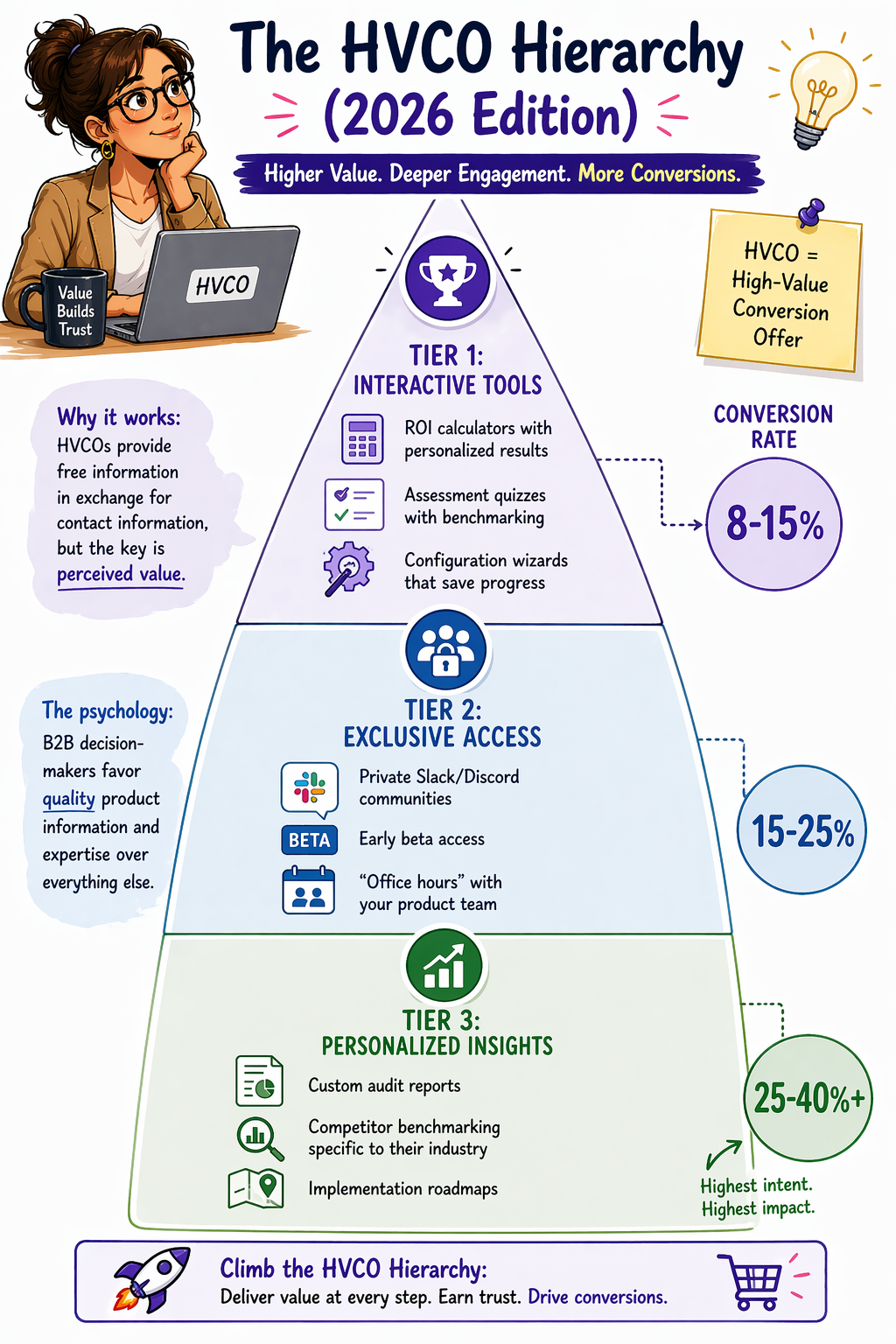
The HVCO Hierarchy (2026 Edition)
Tier 1: Interactive Tools
- ROI calculators with personalized results
- Assessment quizzes with benchmarking
- Configuration wizards that save progress
Why it works: HVCOs provide free information in exchange for contact information, but the key is perceived value.
Tier 2: Exclusive Access
- Private Slack/Discord communities
- Early beta access
- "Office hours" with your product team
The psychology: B2B decision-makers favor quality product information and expertise over everything else.
Tier 3: Personalized Insights
- Custom audit reports
- Competitor benchmarking specific to their industry
- Implementation roadmaps
The HVCO That Converts:
One SaaS company saw a 451% boost in qualified leads by combining AI chatbots with strategic HVCOs using BANT qualification.
High-Value Content + Strategic Timing + Zero Friction = Qualified Lead
The Loop System: Where Magic Happens
Here's where most companies fail: They treat chat, email, blog, and outreach as separate channels. Big mistake.
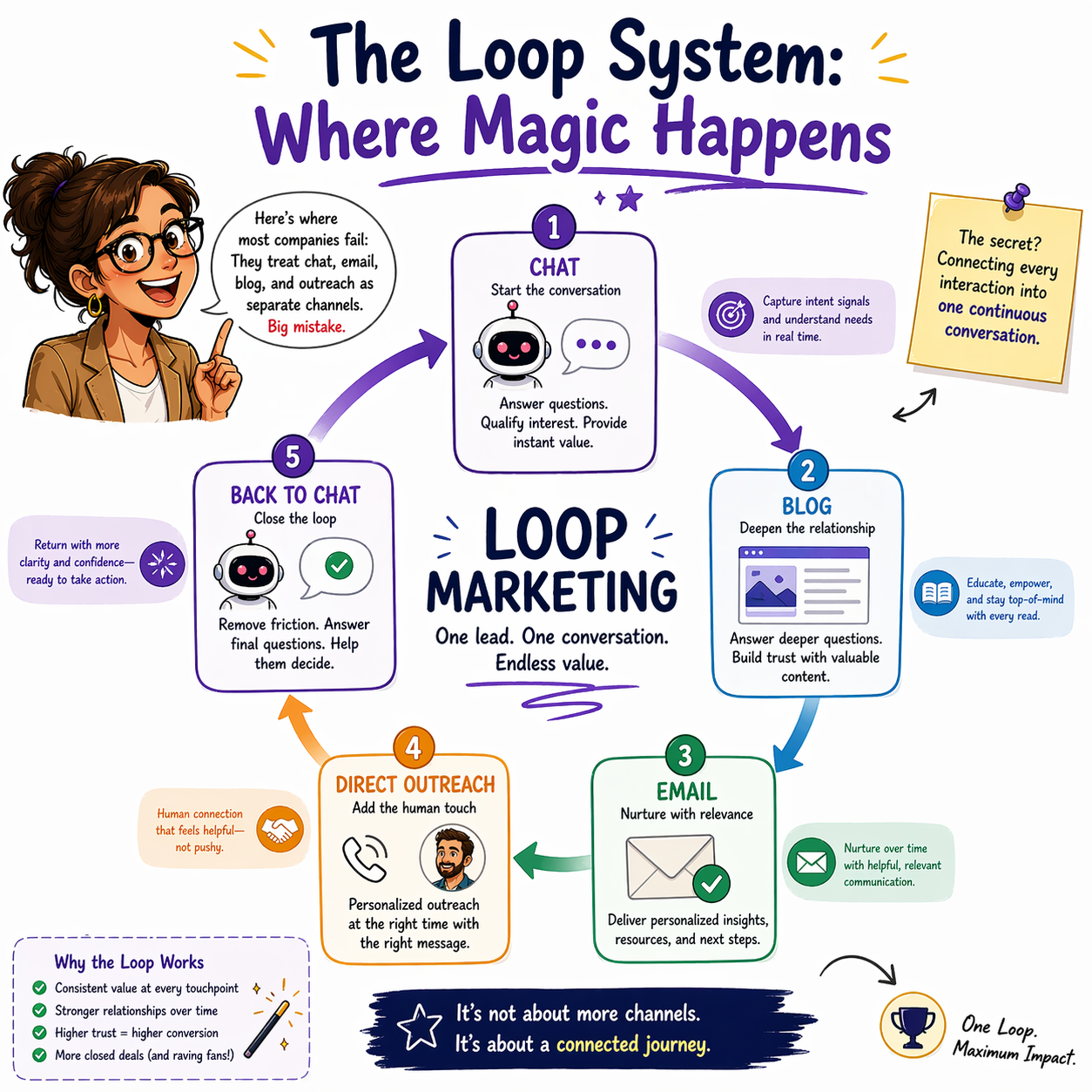
The Closed-Loop Content Marketing Framework
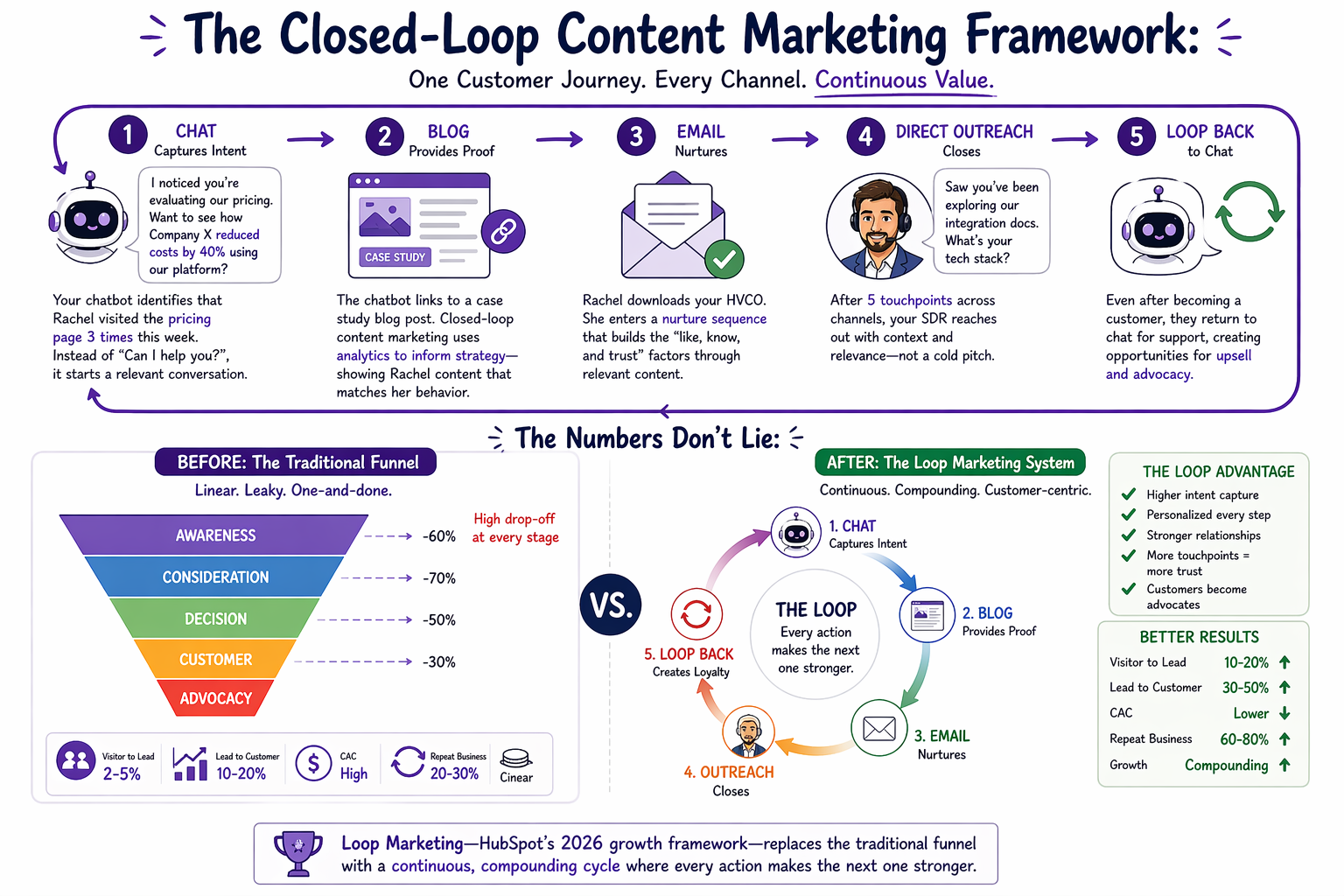
Step 1: Chat Captures Intent
Your chatbot identifies that Rachel visited the pricing page 3 times this week. Instead of "Can I help you?", it says: "I noticed you're evaluating our pricing. Want to see how Company X reduced costs by 40% using our platform?"
Step 2: Blog Provides Proof
The chatbot links to a case study blog post. Closed-loop content marketing uses analytics to inform strategy — showing Rachel content that matches her behaviour.
Step 3: Email Nurtures
Rachel downloads your HVCO. She enters a nurture sequence that builds the "like, know, and trust" factors through relevant content.
Step 4: Direct Outreach Closes
After 5 touchpoints across channels, your SDR reaches out: "Saw you've been exploring our integration docs. What's your tech stack?"
Step 5: Loop Back to Chat
Even after becoming a customer, they return to chat for support, creating opportunities for upsell and advocacy.
The Numbers Don't Lie
Loop Marketing — HubSpot's 2026 growth framework — replaces the traditional funnel with a continuous, compounding cycle where every action makes the next one stronger.
Demographic Profiling: Beyond Age and Income
Yes, demographics matter. But not in the way you think.
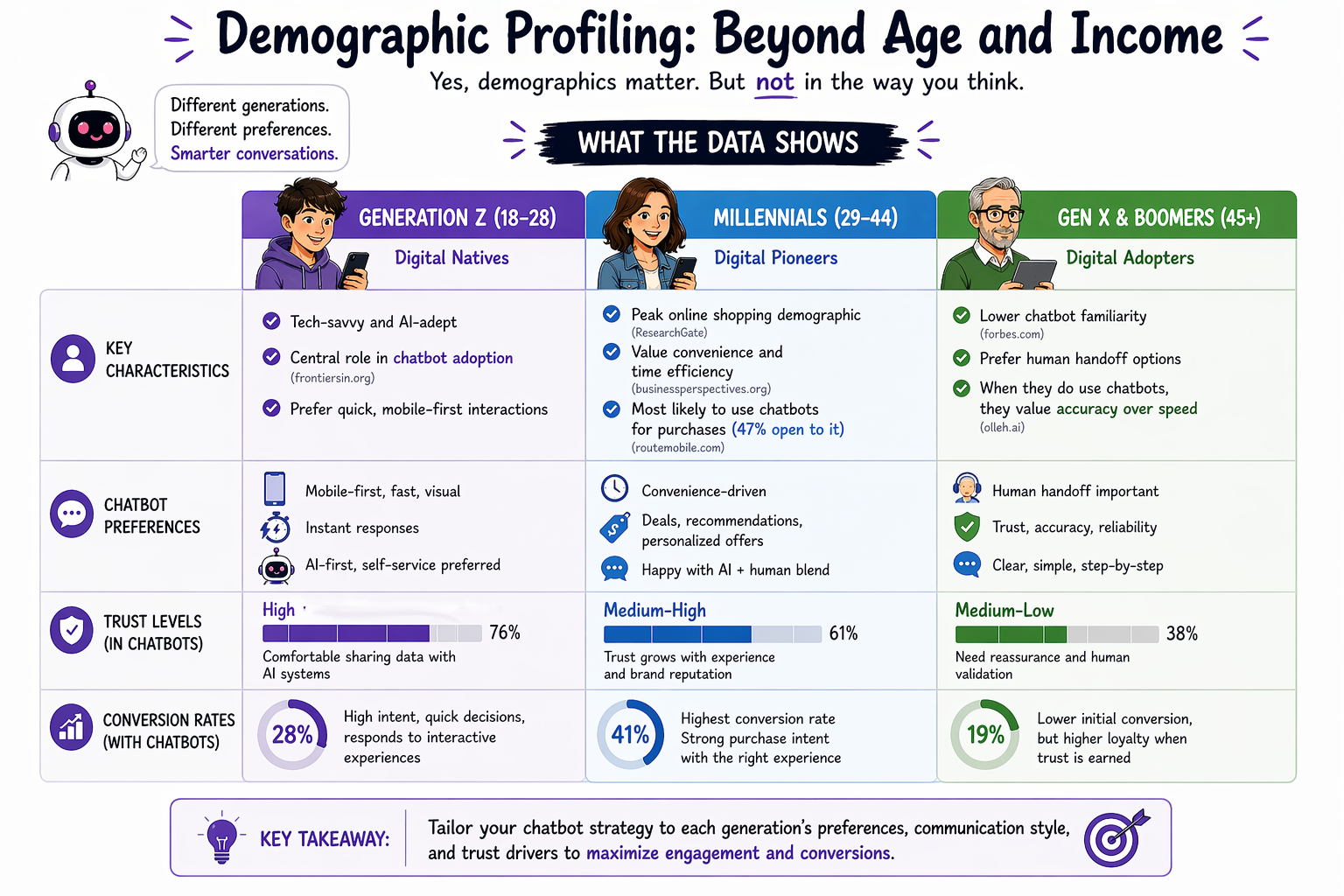
What the Data Shows
Generation Z (18–28):
- Tech-savvy and AI-adept
- Prefer quick, mobile-first interactions
- 80% expect self-service options
Millennials (29–44):
- Peak online shopping demographic
- Value convenience and time efficiency
- Most likely to use chatbots for purchases (47% open to it)
Gen X & Boomers (45+):
- Lower chatbot familiarity
- Prefer human handoff options
- When they do use chatbots, they value accuracy over speed
Behavioural Demographics (The Real Gold)
Forget age. Track these instead:
1. Role-Based Behaviour:
- Decision-makers: Visit pricing, request demos, short sessions
- Influencers: Deep-dive into features, longer sessions, share links
- End-users: Focus on integration docs, support articles
2. Company Size Signals:
- Enterprise: Multiple stakeholders, longer evaluation cycles
- SMB: Faster decisions, price-sensitive, value speed
3. Industry Patterns:
- Tech companies: Expect API docs, security compliance
- Traditional industries: Need education, hand-holding, ROI proof
The Psychology of the "Yes": Trust Signals That Convert
Remember: B2B buyers trust peers nearly 2x more than AI chatbots. So how do you bridge that gap?
The Trust Stack
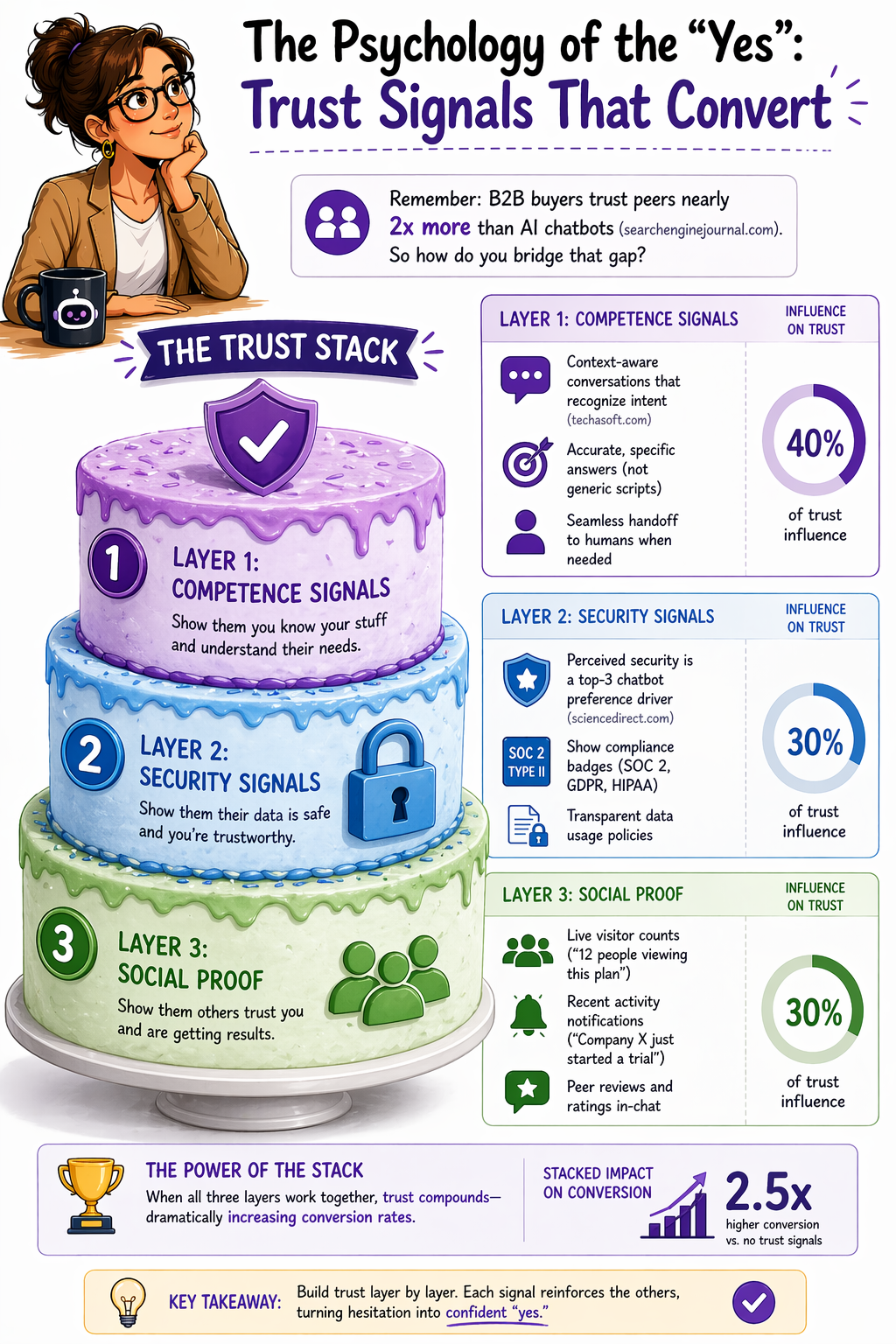
Layer 1: Competence Signals
- Context-aware conversations that recognise intent
- Accurate, specific answers (not generic scripts)
- Seamless handoff to humans when needed
Layer 2: Security Signals
- Perceived security is a top-3 chatbot preference driver
- Show compliance badges (SOC 2, GDPR, HIPAA)
- Transparent data usage policies
Layer 3: Social Proof
- Live visitor counts ("12 people viewing this plan")
- Recent activity notifications ("Company X just started a trial")
- Peer reviews and ratings in-chat
The 3-Second Rule
Chatbots may aid in boosting client engagement by offering fast, individualised responses. But here's the catch: You have 3 seconds to prove value.
❌ Bad: "Hi! How can I help you today?"
✅ Good: "Welcome back! Ready to finish that ROI calculation?"
🚀 Better: "I see you're comparing our Pro vs. Enterprise plans. Here's what most companies your size choose..."
Your Action Plan: From Browser to Buyer
Ready to put this into practice? Here's your 30-day roadmap:
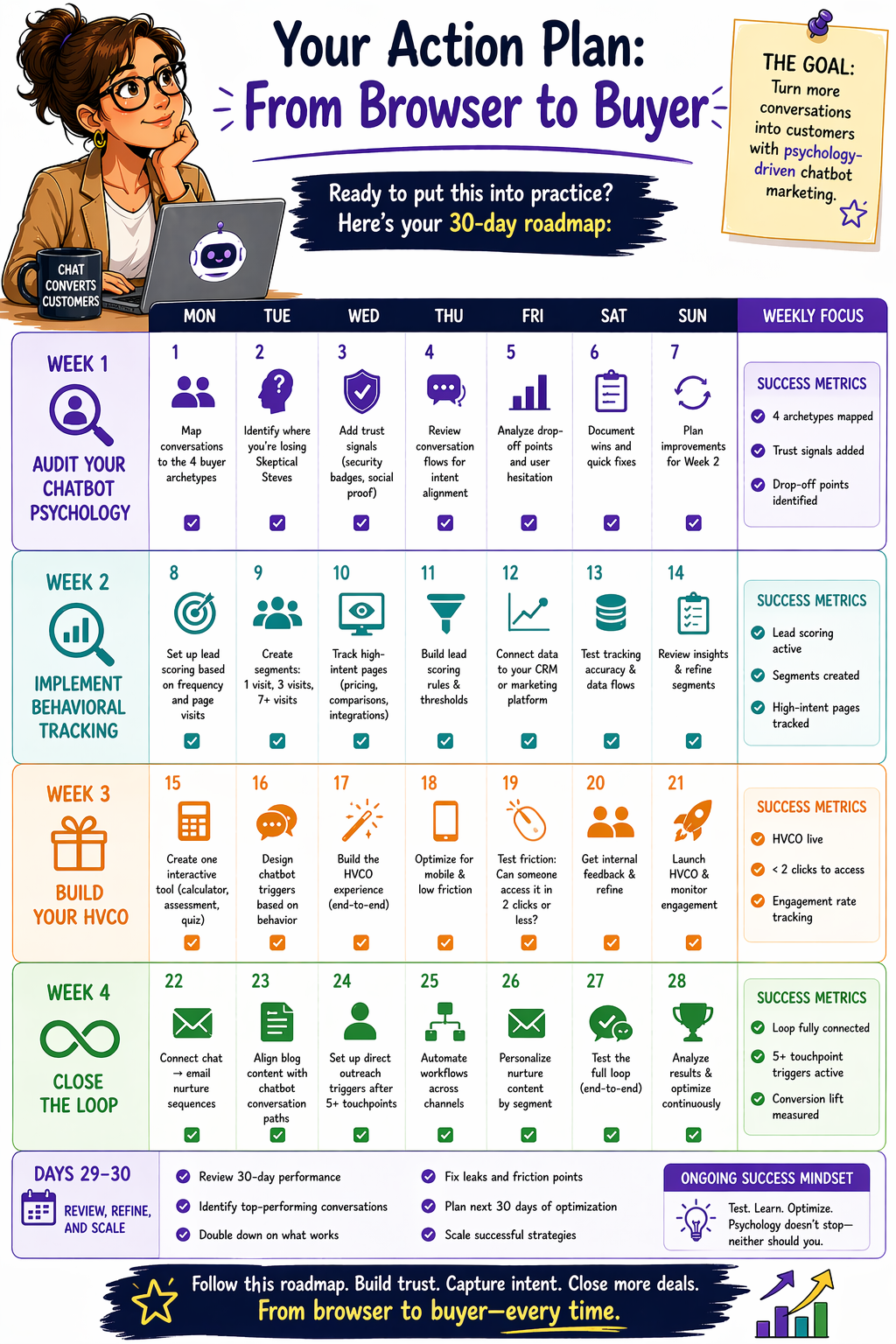
Week 1: Audit Your Chatbot Psychology
- Map conversations to the 4 buyer archetypes
- Identify where you're losing Skeptical Steves
- Add trust signals (security badges, social proof)
Week 2: Implement Behavioural Tracking
- Set up lead scoring based on frequency and page visits
- Create segments: 1 visit, 3 visits, 7+ visits
- Track high-intent pages (pricing, comparisons, integrations)
Week 3: Build Your HVCO
- Create one interactive tool (calculator, assessment, quiz)
- Design chatbot triggers based on behaviour
- Test friction: Can someone access it in 2 clicks or less?
Week 4: Close the Loop
- Connect chat → email nurture sequences
- Align blog content with chatbot conversation paths
- Set up direct outreach triggers after 5+ touchpoints
The Bottom Line: It's Not About the Bot
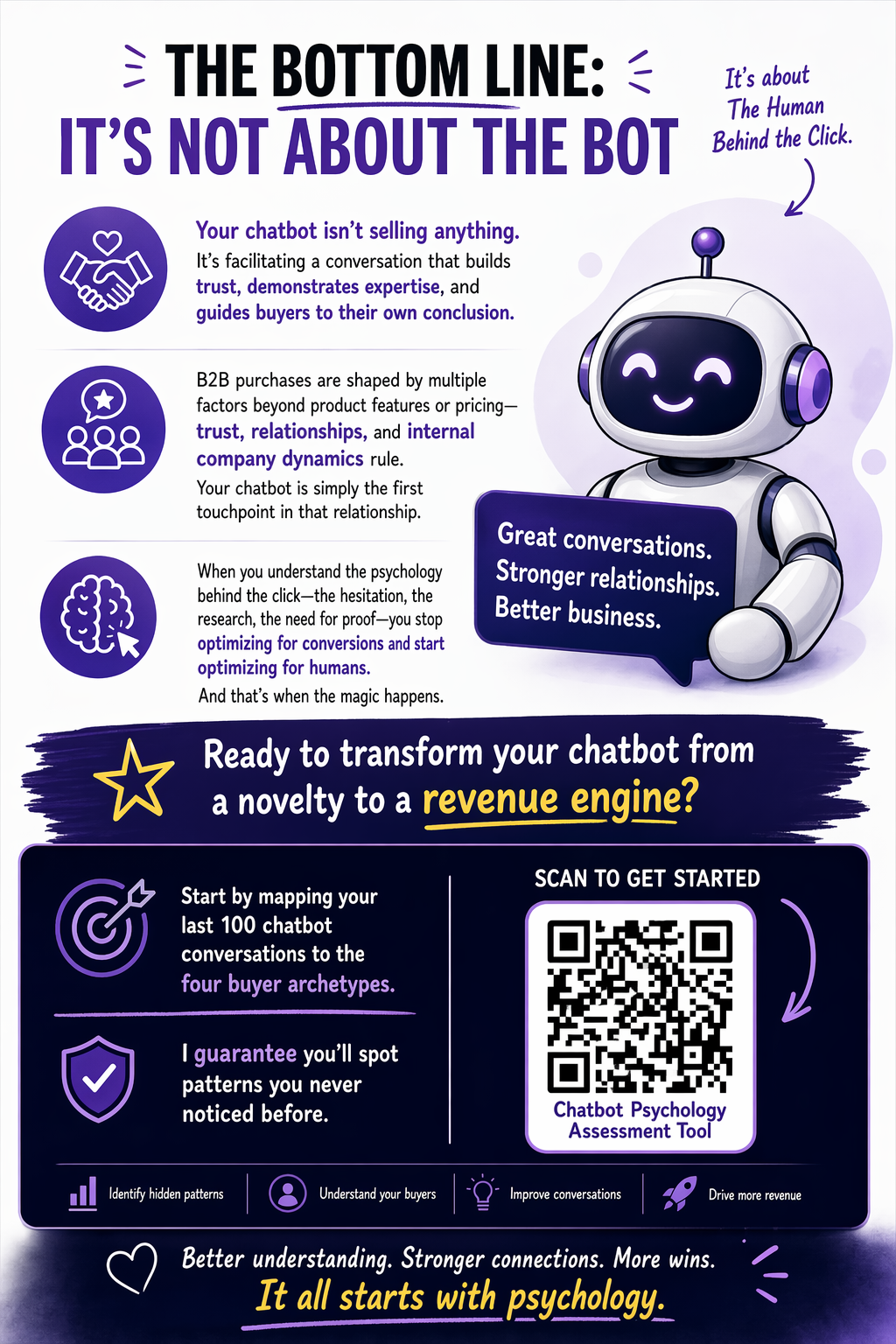
Here's the truth: Your chatbot isn't selling anything. It's facilitating a conversation that builds trust, demonstrates expertise, and guides buyers to their own conclusion.
B2B purchases are shaped by multiple factors beyond product features or pricing — trust, relationships, and internal company dynamics rule. Your chatbot is simply the first touchpoint in that relationship.
When you understand the psychology behind the click — the hesitation, the research, the need for proof — you stop optimising for conversions and start optimising for humans.
And that's when the magic happens.
Ready to transform your chatbot from a novelty to a revenue engine?
Start by mapping your last 100 chatbot conversations to the four buyer archetypes. I guarantee you'll spot patterns you never noticed before.
Get in TouchWhat's your experience been with chatbot buyers? Which buyer persona gives you the most trouble? Reach out at sales@reachout.systems — we'd love to discuss.
Sources & Further Reading
- The role of landing pages and chatbots in B2B lead generation — sciencedirect.com
- B2B Buyers Trust Peers Over AI Chatbots — searchenginejournal.com
- How AI Chatbots Can Boost Website Conversions by 35% — zentricsolutions.com
- Behavioural lead scoring frameworks — avrion.co.uk
- HVCO strategies for lead generation — wealthyaffiliate.com
- Loop Marketing framework — newbreedrevenue.com
Spencer Griffiths
CEO, ReachOut.Systems