
There's a 90-Day Window to Win a Customer Back — After That, They're Gone
Decades of research point to the same uncomfortable truth: once a customer has been silent for three months, your chances of getting them back drop sharply. Most UK businesses miss the window entirely. Here is what the evidence says — and what you can do about it.
Think about the last customer you lost. Not the one who complained or left a negative review — those are easy to spot. Think about the one who simply stopped. No argument, no explanation, no goodbye. They just went quiet and never came back.
The uncomfortable reality is that this happens silently, and constantly, in almost every small business in the UK. And the moment you notice — if you notice at all — the window to do something about it has very often already closed. The research on this is not ambiguous. There is a specific window of opportunity. Most businesses miss it because no one is watching the clock.
What the Research Actually Shows
The 90-day threshold is not a marketing heuristic someone invented to sell software. It has its roots in RFM analysis — a direct marketing framework built on Recency, Frequency, and Monetary value that has been used by data scientists since Arthur Hughes formalised it in his 1994 work Strategic Database Marketing. RFM analysis consistently identifies "recency" — how recently a customer last interacted — as the single strongest predictor of whether they will buy again.
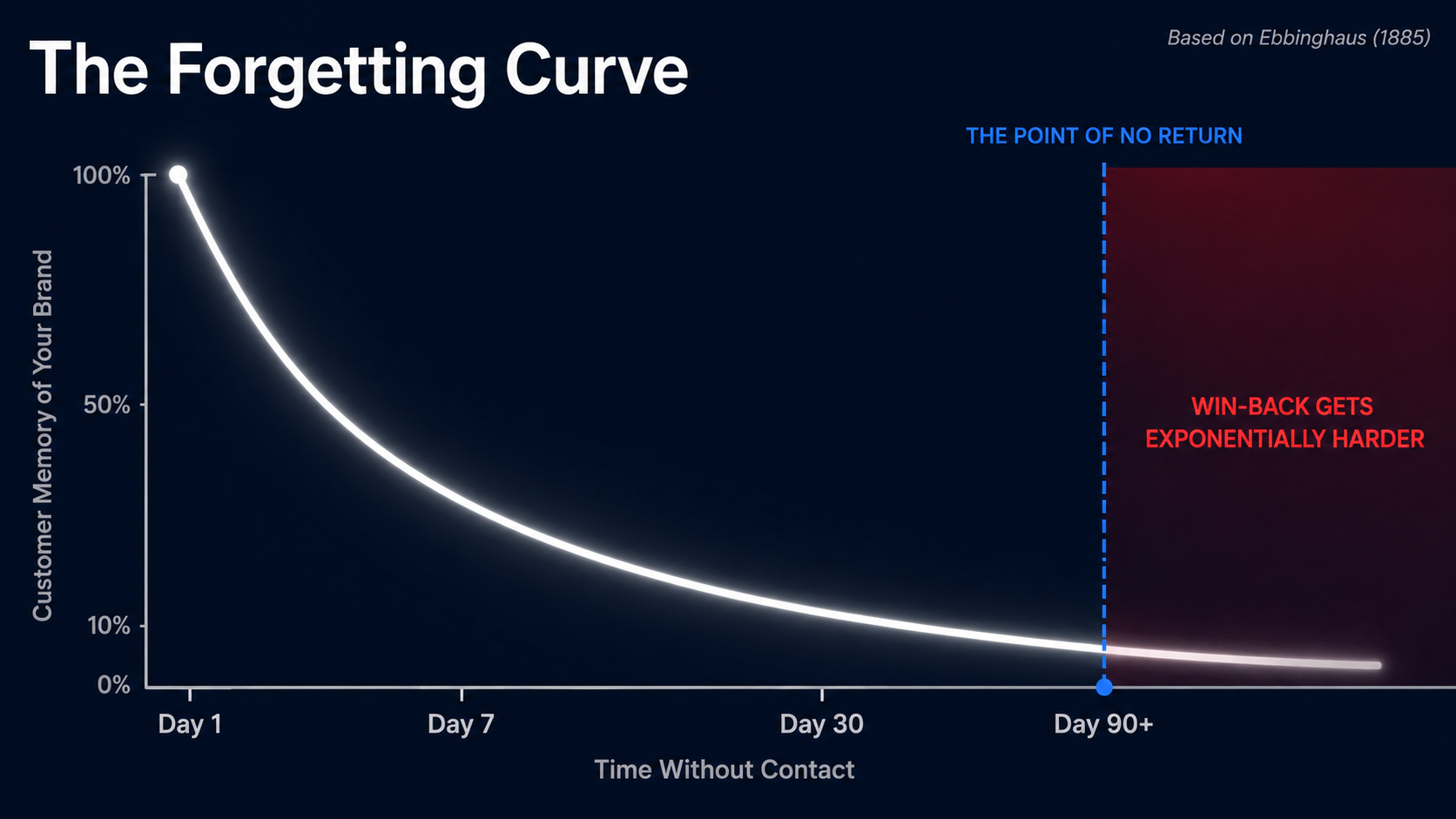
The findings are consistent across industries: a customer who last bought from you within the past 30 days is far more likely to return than one who bought 90 days ago. And one who bought 90 days ago is significantly more likely to return than one who has been silent for six months. The curve is not linear — it drops sharply. The further you move past that 90-day mark, the harder the win-back becomes.
"Recency is the single strongest predictor of future purchase behaviour. A customer who bought last month is dramatically more likely to buy again than one who bought last year."
Arthur Hughes, Strategic Database Marketing (1994)
The Science of Forgetting
There is also a well-established psychological explanation for why the window closes so abruptly. In 1885, German psychologist Hermann Ebbinghaus published Über das Gedächtnis — a landmark study on memory and recall that introduced what became known as the Forgetting Curve. His research demonstrated that, without reinforcement, people forget roughly 50 to 70 per cent of new information within 24 hours, and up to 90 per cent within a week.
Ebbinghaus also identified the counterbalancing mechanism: spaced repetition. Each time a memory is reinforced — each time someone is reminded of an experience — the rate of forgetting slows dramatically. Applied to business relationships, this means that a customer who had a great experience with you in February has, by May, largely stopped thinking about you. Not because the experience was bad. Simply because memory decays, and you gave it nothing to hold onto.
50–70%
of new information forgotten within 24 hours without reinforcement
Ebbinghaus (1885)
5×
more expensive to acquire a new customer than retain an existing one
Invesp Research
25–95%
profit increase from just a 5% improvement in customer retention
Reichheld & Sasser, HBR (1990)
The Economics of Waiting Too Long
In 1990, Frederick Reichheld and W. Earl Sasser published a study in the Harvard Business Review that became one of the most cited pieces of research in customer relationship management. Their headline finding — that a five per cent increase in customer retention could increase profits by between 25 and 95 per cent — shocked the business world at the time and has been validated repeatedly since.
The underlying reason is straightforward. Returning customers cost less to serve, buy more frequently, spend more per transaction, and refer others at higher rates than new customers do. Adobe's Digital Index research found that repeat customers generate roughly three times the revenue per visit compared to first-time buyers. The economics of keeping a customer engaged are, in almost every sector, vastly superior to the economics of finding a new one.
"A five per cent increase in customer retention produces more than a 25 per cent increase in profit."
Frederick Reichheld & W. Earl Sasser, Harvard Business Review (1990)
Win-Back Gets Harder the Longer You Wait
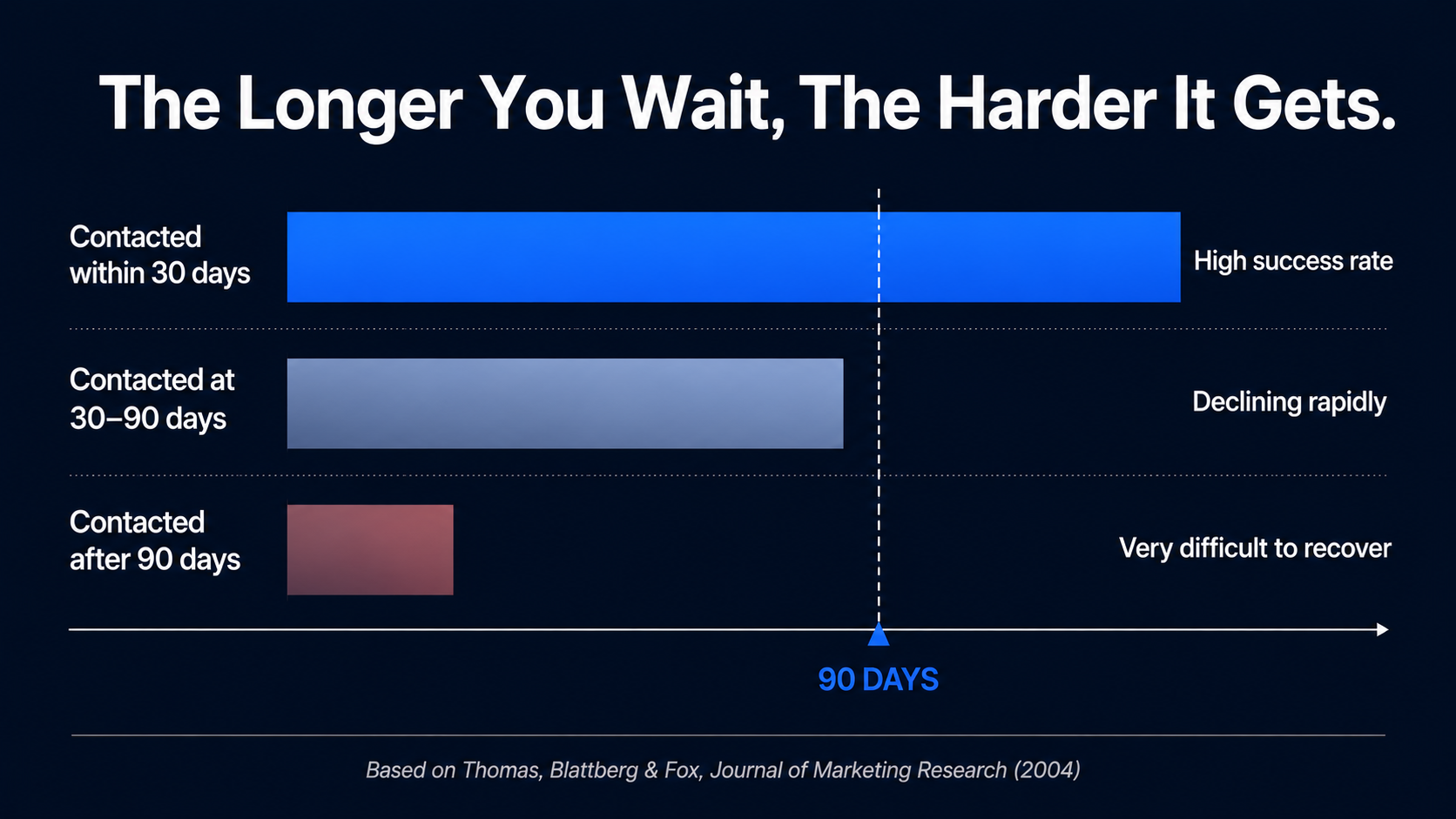
A 2004 study published in the Journal of Marketing Research by Thomas, Blattberg, and Fox — titled "Recapturing Lost Customers" — examined win-back campaigns across thousands of customer relationships and found that the success rate of re-engagement efforts declines measurably with the length of the lapse. Customers contacted within the first 90 days of going quiet responded at significantly higher rates than those contacted after six months or more.
The study also found that customers won back within a short window had higher subsequent lifetime value than those who were allowed to lapse for longer. The practical implication is important: you are not just racing against a forgetting curve. You are racing against the moment your customer finds, tries, and becomes satisfied with a competitor. Once that transition has happened, the relationship is not just dormant — it has been actively replaced.
Why Most UK Small Businesses Miss the Window
None of this is new information. Larger businesses with dedicated CRM teams and marketing departments have been acting on this research for years. The problem for UK small and medium-sized businesses is not awareness — it is capacity. When you are running operations, managing people, handling customers directly, and keeping the business solvent, monitoring which customers went quiet 60 days ago is not anyone's job. It falls through the gap because there is no gap — there is only an impossibly full day.
The result is that most SMBs interact with a customer at the point of sale and then hope that customer comes back on their own. Some do. Many do not. And the ones who drift away quietly — who represented future revenue, potential referrals, and a relationship you already invested in building — simply disappear into a spreadsheet that nobody looks at.
What Changes When You Catch It in Time
The businesses that succeed at customer retention are not necessarily doing anything more sophisticated than the ones that fail. They are simply reaching out at the right time. A well-timed, relevant message — sent within that 90-day window while the memory of a positive experience is still intact — lands very differently from the same message sent six months later.
It does not need to be a discount or an aggressive sales pitch. Research on win-back campaigns consistently shows that customers respond best to messages that feel personal and relevant — that acknowledge the relationship rather than treating the recipient as a cold prospect. A simple, well-worded message that says "we noticed it has been a while and wanted to check in" outperforms a generic promotional email in almost every study.
The key variable is not the message itself — it is the timing. And timing, at scale, is precisely what most small businesses cannot manage manually.
Catching the Window Automatically
ReachOut.Systems was built specifically around this problem. The platform monitors engagement across your customer base continuously, flags customers who are approaching the critical window, and sends thoughtful, personalised outreach on your behalf — timed to land before the relationship has fully faded. Nothing goes out without your approval, and every message is adapted to the individual recipient.
The businesses already using the platform are not doing anything that large companies have not been doing for years. They are simply doing it without needing a marketing department, a CRM manager, or a three-thousand-pound monthly agency retainer to make it happen.
The window is open right now for some of your customers.
Find out who — before it closes.
Book a Free ChatReferences
- Ebbinghaus, H. (1885). Über das Gedächtnis: Untersuchungen zur experimentellen Psychologie. Duncker & Humblot. (Translated: Memory: A Contribution to Experimental Psychology, 1913.)
- Reichheld, F. F., & Sasser, W. E. (1990). Zero defections: Quality comes to services. Harvard Business Review, 68(5), 105–111.
- Hughes, A. M. (1994). Strategic Database Marketing. Probus Publishing.
- Thomas, J. S., Blattberg, R. C., & Fox, E. J. (2004). Recapturing lost customers. Journal of Marketing Research, 41(1), 31–45.
- Reichheld, F. F., & Schefter, P. (2000). E-loyalty: Your secret weapon on the web. Harvard Business Review, 78(4), 105–113.
- Adobe Digital Index. (2012). The ROI from Marketing to Existing Online Customers. Adobe Systems.
- Invesp. (2023). Customer Acquisition vs Retention Costs — Statistics and Trends. Invesp Consulting.